
The Avengers Infinity Quest

Average Prices: USD $6,700 to $8,800
Produced: September, 2020
Machine Type: Solid State Electronic
Players: 4

Design by: Keith Elwin
Art by: Jeremy Packer, Zombie Yeti
Dots/Animation by: Chuck Ernst, Joshua Clay
Mechanics by: Harrison Drake
Music by: Ken Hale
Sound by: Jerry Thompson
Software by: Mike Kyzivat, Rick Naegele, Brett Z Rubin, Raymond Davidson
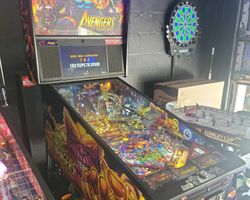
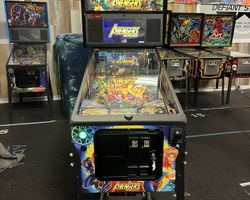
Released in September 2020 by Stern Pinball, Avengers: Infinity Quest represents a significant departure from the manufacturer’s previous attempt at the Marvel franchise. While Stern produced an Avengers machine in 2012 designed by George Gomez, this 2020 iteration was handed to Keith Elwin, a designer who transitioned from a world-class competitive player to one of the most respected architects in modern pinball. Working alongside lead artist Jeremy Packer, better known as Zombie Yeti, Elwin and his team aimed to create a kinetic experience that mirrored the frantic energy of the Marvel comic books.
The development of the machine focused on a "quest" narrative rather than a direct retelling of any specific film. This comic-centric approach allowed the creative team more freedom with the visual assets and character designs, avoiding the licensing hurdles often associated with the Marvel Cinematic Universe actors' likenesses. The production run included three distinct tiers: the Pro, the Premium, and the Limited Edition, the latter of which was restricted to only 500 units worldwide.
Distinctive Features Across the Tiers
The machine's physical presence is defined by several mechanical "toys" that dictate the flow of the game. A central feature across all models is the Avengers Tower, a vertical structure that utilizes a magnet to catch the ball and holds it for multiball locks. Another standout is the Dr. Strange spinning disc. On the Pro model, this is a fixed spinning target that deflects the ball to create chaos on the playfield. However, on the Premium and Limited Edition models, this mechanism is significantly more complex; the disc can rise to reveal a hidden subway entrance, facilitating a "portal" ball lock that physically holds balls beneath the playfield.
The most discussed mechanical difference between the models is the Captain Marvel ramp. On the Pro, this is a standard, albeit steep, ramp. On the Premium and LE versions, it is a custom-molded "gravity-defying" wireform that carries the ball in a complete vertical loop before returning it to the flipper. This creates a high-speed orbital sensation that many players find rewarding, though it requires precise flipper timing to complete.
The Limited Edition further distinguishes itself with aesthetic and functional upgrades. It features high-definition "anti-reflection" playfield glass, a custom "Infinity Yellow" powder-coated cabinet armor, and a mirrored backglass. Internally, the LE is equipped with an upgraded audio system to enhance the soundscape provided by composer Ken Hale and sound designer Jerry Thompson.
Playfield Architecture and Flow
The layout of Avengers: Infinity Quest is often described as a "shooter’s dream" due to its intricate geometry. Keith Elwin’s design philosophy emphasizes flow and "combos"—the ability to hit multiple shots in a continuous sequence without the ball stopping. The playfield features three flippers: two at the bottom in the standard configuration and a third high-speed flipper positioned mid-right. This third flipper is essential for hitting the Hawkeye loop and the Captain Marvel ramp, shots that are central to the game's progression.
The playfield contains five ramps on the higher-tier models and four on the Pro. These ramps are intertwined in a way that maximizes the use of the upper third of the cabinet. The artwork by Zombie Yeti is dense and vibrant, utilizing a comic-book aesthetic that covers every inch of the wood and plastics. The lighting system is deeply integrated into the gameplay, with color-coded inserts indicating which "gem" quest is active and which shots are required to progress.
The mechanical heart of the game is the interactive Dr. Strange disc and the triple-bank of drop targets. These targets are not merely for points; they are used to "spell" out requirements and qualify the various quests. The placement of the captive ball and the spinners adds layers of kinetic feedback, ensuring the player is constantly managing multiple objectives across the wide-open lower playfield.
Tactical Gameplay and Gem Mechanics
The depth of the ruleset is what separates this machine from more linear designs. The primary objective is to travel across the map to different locations to recover the six Infinity Gems: Power, Space, Reality, Soul, Mind, and Time. Each gem quest functions as a unique mode with specific shot requirements and timers.
What makes the game strategically deep is the ability to "place" a collected gem onto a specific Avenger. For example, placing the Power Gem on the Hulk might increase the scoring potential of his specific shots, while the Time Gem can be used to extend mode timers. This adds a layer of RPG-like resource management, where players must decide which buffs are most beneficial for their specific playstyle or the current state of the game.
The Soul Gem mode is frequently cited by enthusiasts as a highlight. It is a "limited flip" mode, where the player is given a set number of flipper activations to complete a series of shots. This turns a high-speed game into a calculated, high-tension exercise in precision. Scoring is heavily dependent on "stacking"—the process of running a multiball mode simultaneously with a gem quest. By doing so, the extra balls on the playfield make it easier to hit difficult targets while providing a safety net against drains.
Community Standing and Influence
The reception of Avengers: Infinity Quest has been characterized by a divide between casual players and the competitive community. High-level players often praise the machine for its incredible "lastability" and the complexity of its software. The layout is widely considered one of the best of the modern era, offering a variety of shots that remain satisfying even after hundreds of plays.
However, the machine has faced criticism regarding its learning curve. The ruleset is dense, and without a thorough understanding of the gem mechanics, a casual player may find the experience confusing or punishing. The outlanes are notoriously "hungry," often leading to quick games for those who have not mastered the nuances of the flipper physics. Additionally, some players have expressed that the stock animations on the LCD screen and the voice callouts lack the cinematic weight found in other licensed titles.
Despite these critiques, the machine remains a staple in tournament play and home collections. Its influence is seen in the way subsequent Stern titles have approached deep, non-linear rulesets. Avengers: Infinity Quest proved that a pinball machine could function as a complex strategy game, rewarding those who take the time to study its mechanics and master its difficult, high-speed layout. It stands as a testament to the evolution of the hobby, moving away from simple point-chasing toward a more immersive, objective-based experience.
Sponsored Links
 Ebay Listings
Auction Results
| Edition | Cost | Location | Date |
|---|---|---|---|
| Pro | USD $5,500 |  United States United States |
15 October, 2026 |
| Pro | USD $5,500 | United States |
07 October, 2026 |
| Premium | USD $5,900 | United States |
26 September, 2026 |
| Limited Edition | USD $9,100 | United States |
24 September, 2026 |
| Premium | USD $7,000 | United States |
11 September, 2026 |
| Premium | USD $8,300 | United States |
29 August, 2026 |
| Pro | USD $5,499 | United States |
08 July, 2026 |
| Limited Edition | USD $9,870 | Indiana, United States |
20 May, 2026 |
| Premium | USD $7,200 | Massachusetts, United States |
15 May, 2026 |
| Pro | USD $4,800 | Colorado, United States |
30 April, 2026 |




Private Policy · Search Website · Contact Us
As an eBay Partner, we may earn a commission from qualifying purchases made through links on this site, at no additional cost to you.
All trademarks and copyrighted materials remain property of their respective owners. All other content copyright 2007 - 2026 Pinpedia.
